
Calling the LLM is the easy part. The course is about the rest.
The hard parts: getting consistent answers, comparing provider costs, and making your RAG pipeline improvable. The course covers all three.
Sign up at Valohai AcademyFree. Six modules. By Valohai.
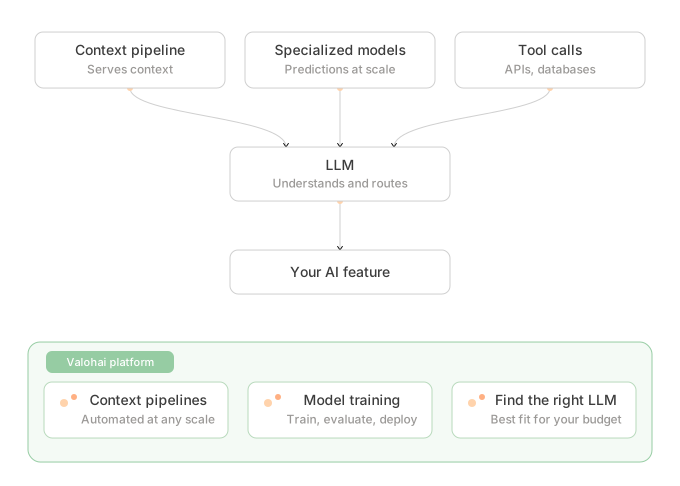
Three things that get harder once your LLM feature is live.
Cost climbs quietly.
OpenAI, Anthropic, and self-hosted Llama can all run the same workload, at very different prices. Most teams pick one and stay there, because there's no dashboard that compares them side by side. The same workload can cost 12x more depending on which one's running it.
Prompt changes ship before they’re tested.
You change a prompt, run three quick tests, they pass, you ship. Then a customer hits a regression the tests didn't cover. An eval suite runs every prompt change against hundreds of realistic cases. The regression shows up there, before customers see it.
RAG pipelines stop improving.
Your RAG pipeline works for most queries. The 30 percent it gets wrong look random. Changing chunk size, embedding model, or retrieval depth could fix them, or make them worse. There's no harness to compare variants on real queries.
Six modules. Roughly eight hours. Three of them are about the parts above.
- Understanding LLMs for product development. When to reach for an LLM, when traditional ML, rules, or a database query is the better tool.
- Prompt engineering fundamentals. Structured prompts, few-shot patterns, structured outputs, the iteration loop.
- Context management. Static context, RAG, fine-tuning, agents, chaining. Six strategies in order of cost.
- Building LLM-powered features. Validation layers, retries, provider fallbacks, when an agent helps and when it hurts.
- Evaluating LLM outputs. (The longest module.) Building eval sets, layered evaluation, regression suites that block PRs.
- Going to production. Cost tracking, model routing, prompt caching, quality drift, the weekly improvement rhythm.
Taught by Petteri.

Petteri is Head of Product at Valohai. Before joining, he led LLM implementations inside enterprise products, where shipping carefully wasn’t optional. The course is the playbook from those teams, plus what he sees across Valohai’s customer base now.
“The same problems keep showing up in the same order across teams. After enough of that, the lessons are worth writing down. This course is those lessons.”
By the end of the course, you’ll have:
- A way to compare LLM providers on quality and cost for your actual workload.
- A regression test suite that catches bad prompt changes before they ship.
- An iterable RAG pipeline, with side-by-side comparison across chunk size, embedding model, and retrieval depth.
- A framework for deciding when an LLM isn’t the right answer.
Start the free LLM course.
Six modules, hosted on Valohai Academy. Free to sign up, start whenever.
Sign up at Valohai Academy